Showing posts with label nikon. Show all posts

Thursday, 4 February 2010

Nikon CMOS based DX DSLR


2010-02-05_190949

The current line up of Nikon cropped sensor DSLR (DX) is based around a  12.3 mpix CMOS sensor coupled with a new 14 bits processor (Expeed in Nikon terminology).

This sensor/processor combination has been implanted first in the D300 released in 2007 alongside the similar technology full frame CMOS sensor camera the D3. It was used as a basis for the expert model D90 (2008) and the entry-amateur model d5000 (2009). The D300s constitute an update of the 2007 model, which include video capture and some other minor improvements.

The D300-based series described above constitute a substantial upgrade compared to its predecessor based on the sensor/processor combination initiated on the D200. Please note that D80 and d3000 are also based on this architecture.

Main differences between D300 and D200

  D200 D300
  frontview-001 2010-02-05_192643
sensor CCD 10.2 mpix CMOS 12.3 mpix
processor 12 bits 14 bits
LCD low res 2.5”/230k high res 3”/920k
AF areas 11 51
max fps 5 7 (8 wt grip)
meter same same
live view No Yes
sensor cleaning No Yes
D-lighting No Yes
max iso 100-3200 100-6400
max usable iso 800 1600
viewfinder 95x 94x

Substantial improvements  include

  • Better low ISO and dynamic range performance
  • Better, bigger and higher res LCD (3”/920k)  for  D300/300s/90, smaller res but movable LCD for d5000
  • Better battery performances (with for most model same type of battery EN-EL 3e for D200/300/300s/90)
  • In camera corrections like Dynamic Range optimization (D-lighting) or for lens defect like lateral fringes
  • Introduces live view and video capability (except D300)

The three main models currently available with the 12.3 Cmos sensor differ mainly in built and mechanical aspects which affect price and weight, the image quality is largely comparable.

These are the main differences

D300S

Same as D300 plus

  • HD Video capture (720p/24fps), stereo input,
  • Dual card slot (CF+SD)
  • Live view with dedicated button and artificial horizon

D300

Main differences vs D90/D5000

  • Bigger viewfinder
  • More dedicated buttons
  • More sophisticated metering sensor
  • Can matrix meter manual lenses
  • Heavier and more weather resistant mostly metal body
  • High speed operation and frame rate
  • Faster and more precise AF (51 points)

D90

Main differences with D300

  • Smaller and lighter plastic body – not sealed
  • Smaller finder
  • But same LCD screen
  • Slight advantage in high ISO performance
  • Cannot meter with manual (non-chipped) lenses
  • Less precise 11 areas AF system
  • Retains two control wheels (thumb and index) controls
  • Uses SD card

D5000

Main differences with D300/D90

  • Lower res LCD movable
  • No AF motor in body, AF only AFS lenses
  • Just one control wheel

 Main differences between D300/D90 and D5000

  D300 D90 D5000
Body 2010-02-05_192643
finder 94x/100% 94x/96% 78x/95%
AF 51 11 11
LCD high res 3”/920k high res 3”/920k 2.7”/230k moving
Meter 1005-pixel RGB 420-pixel RGB 420-pixel RGB
meter Ai/Ais Y N N
Weight empty 840g 620g 560g
Price 1200-1500 700-900 500-700

Please note that D200 and D300 share a similar chassis based on F100. D80 and D90 share similar chassis based on F80.
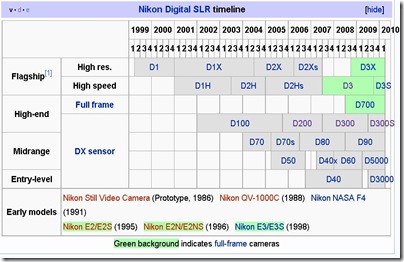
 2010-02-05_184910

source wikipedia

Images DPreview, DxO

Tuesday, 14 April 2009

Nikon D5000

IT'S OUT !!!! (But D400 not...)

The dark lord ... with a microphone (image Nikon)

D5000 is the update of the D60 entry model DSLR - so it's compact, DX APS-C format and has no auto focus motor, needs lenses with built-in AFS motor basically all DX format lenses in Nikon range are (except 10mm fisheye). Does have vibrating sensor cleaning system plus airflow. Uses SD card. No dedicated grip foreseen by Nikon (possibly a market brand will be available as it is the case for D40/60, although not sure existing one can be used).

It borrows from D90/300 higher range models: CMOS 12 Mpixels image sensor and image processor, so we can expect very good image quality and above average low ISO performance, which I hope will be confirmed in future tests. AF sensor is the 11 point module with focus tracking capacity found in D90, which is clearly an upgrade from D60's 3 sensors AF module.

What's really new: movable screen although lower resolution than D90/D300, Live View but slow AF performance in this mode, movie recording capacity, upgraded battery, new body but with traditional Nikon layout.

Movie mode: 16/9, 720p, 24fps with HDMI output - so no full HD. No autofocus during recording but stablisation functions with VR lenses. Max recoding in high quality 720p format 5 min.

What I consider weak points are rather related to the structure of the camera, where economical imperatives clash with what you would expect in a Nikon camera that is many dedicated buttons, big bright finder to facilitate composition and a sturdy frame. In fact the viewfinder on the D5000 is even smaller than on the D60, there is no rotating selection wheel in front of shutter button, no depth of field preview button, etc. The camera is clearly not weather sealed contrary to what Nikon promotional video seems to imply (see other posting)

Raw capacity: Image processor is 12bit only and Raw mode is compressed - those using Raw intensively will probably turn to more capable upper end cameras.

The positive aspects is that basically you get a D90 image quality (possibly slightly improved by 6 further months of devlopment) plus movable LCD screen (which is always cool) in a compact package.

For manual lenses shooters, the camera while probably unable to meter as there is no metering coupling. This means however that any Nikon lens (with very few exceptions) produced in the past 50 years can be mounted on this camera. And while no auto focus will (ever) be available with manual lenses (obviously...), you can always use the focus confirmation function in the finder.

In addition, all lenses can be used with live view and movable LCD which is interesting in Macro photography. The camera has an automatic function for the correction of lateral chromatic aberration (which is a common problem with older lenses used for digital) and additional cool in camera retouching options like perspective control, D-lighting, etc.

Also, I would be courious to try some older lenses for movies (AF doesn't work with movie mode anyway).

As an interesting note, the D5000 has a dedicated socket to be used with additional GPS module, which will make geotagging simple.

Price is around 700-800 $/Eur body only and 800-900 $/Eur with 18-55 VR kit lens.

The D5000 at first look does not sound like terribly competitive. Frankly at that price I would either spend a little more, forego the movable LCD screen and buy the D90 or use a Canon 500D (possibly with a F/EOS adapter ring) .

But if you want an uptodate Nikon camera in a more compact package, the D5000 is certainly a competent camera.

Friday, 27 March 2009

Good news for wide shooters

The main drawback of Digital is that it kills wide angles.

Let me explain: in APS-C format, given sensor magnification you need to go 12/14mm to get to normal 20mm equivalent. Normal primes are not adapted for digital (deform/cost a lot).

Full frame: normal wides become wides again, but formulas rarely adapted for digital.

Fortunately for APS-C cameras a number of wide zooms have been developed both by camera manufacturer and independent to address these points (reach, digital quality).

Nikon released a 12-24 f4G IF ED to address the requirements of pro shooting with D2X. It has 2 ED glass elements and 3 aspherical lenses.

Roumors have sourfaced recently about the possible release of a new (hopefully cheaper) 10-24 DX f3,5-4,5G.

Canon has a EF-S 10-22mm f/3.5-4.5 USM which has range (16-35mm eqiv.), quality (3 asph lenses) and compactness.

Indipendent manufacturers have provided alternative zooms:

Sigma announced recently a new version of its 10-20mm zoom which is this time is a
f3.5 constant aperture.

Tamron also has released a new lens with more range (10-24mm f3.5-4.5) which replace its wide zoom that was limited to 11-18mm range (which is also marketed by Sony).

Tokina has a 12-24mm f4 constant, which has been upgraded with internal motor to be used with entry Nikon model without AF motor. Pentax/Samsung is same lens. It is a quite solidly built lens and zooming and focus ring are pleasantly damped.

Main characteristics of such zooms are:

- relatively heavy - still usable for reportage

- relatively expensive - begs the serious question whether it is really a lens you need every day

-
all have distorsions - need to spend time on Photoshop to correct

- all have other optical shortcomings (soft corners, flare, etc.) to various degrees - Nikon/Canon probably being the better corrected

- Not adapted for full frame - although some might be used at upper end settings (18-20mm equiv.) for desperate cases.

- All use big filters (77-82mm) that in most cases need to be slim type to avoid (further) vignetting (add at least 50$ to your budget)

- Lower wide angle setting difficult to cover with most flash.

Probably, the best is to use wides with full frame cameras.

APS-C wide angle zooms offer a compromise and all
offer competent packages for around a pound in weight and half a grant in cost (except Nikon and Canon which cost more).

The question
remains whether extreme wide-angle zooms can be used hand held. The lens need to be horizontal to avoid perspective deformation which already with primes would recommend for tripod use all the time. The zooms are not so fast and probably not at their best at wide apertures, so usability in low/available light is limited unless used with high ISO proficient cameras such as D300.

The good news is that if you like hyper-focal these lenses have plenty and this is further enhanced by the digital sensor - so it will be hard to work on defocus areas. Also, close focus is often very interesting (around 24cm in most cases).

Finally, if you really need to go for a wide zoom with an APS-C cameras, the choice is made easier by the wider offer on the market and clearly competitors have done a lot of work to challenge the market leaders.


Friday, 20 March 2009

Nikon AFS 35mm f 1.8 G DX - continued

Now that the lens is available in shops, in Europe it was on display already like a month ago.., the first reviews starts to appear.

[Remarks: what D300 can only resolve 1500 lpm???? so why bother - lets simply use the 18-55 kit lens...]

Many say this is a great lens although it's all plastic (except bayonet, and glass.... of course), it has no scale of distance, the AF is not as snappy as expected, and it's DX only...

Optically, it is soft wide open, therefore need to be stopped for sharper results to f5,6 (optimal performance). The problem is that image quality at corners never really picks up. Moreover, as you stop down color fringes appear - some can be corrected by image processor on D300 (not on entry models D40/40x/60 - hope it is addressed in replacement model (D5000?). Also the lens has distortion - apparently more than you would expect from a "normal" lens. Bokeh (out of focus areas) is nothing special.

So the argument in favor of the so-called normal lens (no distortion, fast lens, can be used at wider stops) looses a bit of appeal. Also not sure that the public was starving for having 50mm. equivalent in DX (smaller) format. These lenses were popular in the past given its affordability (unless superfast 1.2), sharpness and compactness. But in the end nobody wondered why there are so many used 50mm around? For one, a zoom is simply more practical in everyday life.

But also normal is simply not wide enough. Some photographers consider it a short tele. It basically provides narrower angle of view, therefore requires that you stand back further from the subject, but without providing the same reach or stand off capacity as a 90mm or a 105mm, for instance.

So basically, if you ask me I am not going to scramble to buy this lens even if it's cheap.

(see DPreview)

Tuesday, 3 March 2009

Evolution of the Nikon F-mount

(Based on Nikon press release with my comments)


  • Introduced on Nikon’s first lens-interchangeable SLR, the Nikon F (1959)
F lenses have indexing system via coupling fork. Lens mount ring is full and it is not possible to mount them on most modern (D)SLRs.

  • Auto aperture indexing (AI) enables automatic setting of maximum aperture (1977)
F-mount ring is cut to provide indexing on mount. Certain cameras (FM, FE, Modified F5) allows mounting both F (but without meter coupling) and AI.

  • Program auto exposure mode compatibility (1981)
Auto coupling mainly with FA, replaced with CPU on AF lenses.

  • Aperture information exchange with the camera body through CPU communication (1983)
First P-series lenses - 3 in 30 years - 45/2.8P, 500/4P and 1200-1700/5.6-8P

Nikon F bayonet

  • Autofocus compatibility (1983)
F3AF - AF not implemented properly by Nikon before 1988 with F4 and F-501.

Manual focus lenses can be mounted on AF cameras only if AI standard or if modified. Won't meter except with high end models (FA, F4, F5, F6, F100).

AF lenses lose coupling fork and cannot meter with older cameras (F, F2, Nikkormat etc.)

  • Digital SLR cameras compatibility (1995)
Ok D1x is 2001, all lenses focal becomes a 1.5x with smaller than film DX image sensors.

Manual AI standard lenses meter with D200/300/700/3/3x. In addition retain normal focal with full frame (FX) cameras D 700/3/3x. Auto metering capacity restored for manual AI lenses via lens database activated through the menu. Basically you tell the camera which lens is mounted and its minimum f/stop. Works also for matrix metering.

New DSLR entry models (D 40/40x/60) without AF motor get rid of indexing peg. It is possible to mount F lenses (full focus ring) on these cameras. No metering but focus confirmation is available.

F lens converted to AI with official Nikon kit
still compatible with original F mount


For more detail on the evolution of the F-mount see link.

Summary of different versions of manual focus Nikon lenses see link.

Life starts at 50


Many people are anxiously awaiting new cameras from Nikon to be announced at PMA, such as

- D400 - follow on of D300 with 15-16 Mpix and video to match 50D

- D700x - with 24 Mpix as D3x and (?) video

- D5000 or D65 - entry model with D40 chassis, 3" LCD and 12 Mpix D300/90 processor and Image quality, plus live view and video

However, there is no new nikon DSLRs at PMA (Pbay reports).

Instead, Nikon has launched the celebration for the 50th anniversary of the F mount see link.

However, the anniversary falls in June and while certainly a date not to be missed, it is indeed a bit early to celebrate. But they probably didn't want to miss the opportunity at PMA.

What a coincidence, just last week I came across a Nikon F body with FTN finder. It has some marks and scratches but appears in working condition. As with all used mechanical SLR, unless bought with seller's guarantee that the camera has been serviced, it is always safe to check light sealing, exposure times and light meter, etc.


In this case, after replacing the type 625 batteries with a fresh set, the meter has been working on and off. So basically I am still playing with the camera and will soon shoot a roll of film to test it.


It's alive!

Nikon's own definition of the Nikon F

A system oriented, single-lens reflex (SLR) camera with interchangeable viewfinders, finder screens and motor drive capability, and coupled to Nikon F Meter

Talking about system, what I for one would be waiting is a Digital Modul R for Nikon F, like Leica did for the R8/9 model in 2005 (see link). Basically it would be great to be able to mount a digital back on a fine mechanical body such as Nikon's F and F2.

Monday, 2 March 2009

Nikon TC-16A converter


This is a 1.6x teleconverter that provide limited autofocus capacity with manual focus Ai/Ais lenses. It is discontinued but can be found for less than 100$ secondhand. The converter works fully only with certain Nikon cameras. It does not autofocus with DSLR (except D2h/x). The optical quality is very good although you lose up to a stop.

I tried it with the F/N 90 and it works pretty well. It won't autofocus over the whole range of given lens. The process is to focus manually to a given range, such as infinity, mid-range or close range and then activate the autofocus for focus fine tuning by pressing slightly the shutter (as for any AF lens). Focus action is quick and there is little or no hunting.

Clearly the TC/manual lens combination is better suited for for tele lenses. It also work with zooms. I find it particularly useful for portraits as normally the subject moves slightly and focus need to be adjusted constantly. And there is also the focal gain of 1.6x which makes a 50 f1.4 a 80 f2 autofocus.


Here I tried the TC-16A with Voigtkander's 75 mm 2.5 which turns into a 120mm.

(Images: nicovandijk; ixiyizi)

Monday, 23 February 2009

Voigtlander Color Skopar 20mm F3.5 SL II Aspherical


New manual lens from Cosina/Voigtlander, exist in Nikon AIS and Pentax KA mounts.

Cosina Japan announced recently the forthcoming release of this new lens part of the SL lenses series aimed at making available to enthusiasts quality manual lenses in various lens mount (for Nikon, Canon, Pentax).

The main characteristics of these lenses are high built quality and material used, metal hoods (provided with lens or optional), high quality glass including aspheric elements in certain cases, diaphragm with 9 blades for better out of focus background (bokeh) rendition. The most recent releases in the series (SL II) include an electronic chip which allows matrix metering and EXIF recording with more recent digital bodies.


All lenses are totally manual and are for full format cameras, but of course compatible with DX cameras - and you can actually meter with entry level bodies (D40/60). The position of the focusing (front) and aperture (back) rings is compatible with Nikon standards. Cosina finally got rid of the coupling fork - which I personally always found annoying. The lenses cannot meter with older film cameras like the Nikkormat, but probably can still be used with stop down metering.

The Skopar 20mm f3.5 has standard 52mm filter ring. A dedicated hood is also produced and available separately.


Announced Japanese price is 55.000 Yen, which correspond to 460 Eur/550$. However, street price in US should be lower possibly around 400$ or less (estimate). In Europe, comparable SL II series lenses retail at 349 Eur.

So the question is, do we need this lens? In principle you can still get a Nikon 20mm f 2.8 lens new in manual AIS or AFD version. Both lenses are optically identical and only their body construction differs, the AF being plastic to allow focusing motor operation. They have optical correction for close focusing (CRC) with minimum focus distance of 2.5 cm. Glass has normal Nikon coating. Filter is 62mm. AIS version has metal filter threat and can mount metal hood. The AFD version uses a bayonet plastic hood.


The lenses are sharp but have distortion inevitable for such a wide angle. However they retain light and compact features, weighting less than 300 gr. Both lenses can be found new for around 500$ each. The AF version is more plasticky and the AF motor is quite noisy and can be subject to focus hunting (may also depend on camera AF). Frankly for this type of lens I don't see the need for Autofocus mechanism as it has a very high Depth of Field and so it is possible to use it in hyperfocal mode most of the time. Basically, at f8 everything should be in focus from 2 meters to infinity. So the AIS version should be a better choice because it gives you a better Depth of Field scale, and no distraction from focus hunting. Also as it is built more solidly, this version may have more collectable value.

So having two lenses, the Voigtlander and the original Nikon AIS, what can be the respective advantages.

The Cosina is even more compact weighting just 200gr. It uses Nikon standard 52 mm filters. It is one stop slower which many people will consider as a negative point but which in fact allows better corrected glass in general. The fact that it also includes an aspherical element would also lead to think that on paper the Scopar should have better controlled distortion.

On DX, the lens becomes the equivalent of 30mm.

The Nikon AIS is a bit heavy, relatively speaking. You have to carry additional 62mm filters, which BTW should be the pricier slim type as the front lens is quite prominent and you risk vignetting with other filters. Hood is also wide, larger than lens barrel.

Cosina lens appears more compact as the front lens itself is of a smaller diameter which allows mounting the hood in a way that it should not exceed the lens barrel facilitating storage. These features (weight, filter, and hood) make the lens very compact and ideal for travelling. The Depth of Field scale could be more detailed but at least it exists.

For close photography, the Cosina closer focus is 0.2 m although given the CRC correction on the and wider opening on Nikon AIS, the latter would appear better suited.

So overall, this new lens is certainly welcomed and can make an interesting contribution to the serious amateur’s set of equipment. That said like often with Cosina releases of classic design lenses for SLRs (be it under Voigtlander or Zeiss brands and without touching upon the issue of Leica M compatible lenses), these lenses are well built but they don't differ significantly from Nikon's primes.

Also a criticism which is often made by reviewers is the relatively ancient conception of the lens which basically makes it a marginal improvement over classic designs. Because basically, this lens seems inspired by the classic Nikon 20mm AI which existed in f4 and then in f3.5 max aperture version.

The Nikon 3,5 version was actually a more complex design with 11 lenses in 8 groups compared to Cosina's 9 lenses/6 groups. However, Cosina comprises an aspherical element which simplifies lens design. Upgrades of the Cosina over classic 3.5 AIS are inclusion of CPU (although limited use with advanced bodies D200/300/700/3/3x where lens data can be input via menu or programmed Func button) and said Asph lens.

Question marks remain edge performance, distortion, chromatic aberration, coma, resistance to flare etc.

(images: Cosina., photosynhthesis/Roland Vink)

Tuesday, 3 February 2009

Nikon to release two bridge cameras

When Nikon goes Camedia

Nikon is going to release two new bridge cameras the P90 and the L100 in mid-march.


The P90 is the more everything (zoom, price and pixels) model and is an upgrade of the P80.

Main specs: 12.1 Mpix, x24 optical Zoom 26-624mm (35mm equiv.)

It has a tilting LCD screen, better ED lenses, proprietary lithium battery and charger. 15FPS. All this for around 400$/350Eur.


The L100 is the top of a new budget L-range. It has a bit less impressive specs but comes cheaper.

Main specs: 10 Mpix, x15 optical Zoom 28-420mm (35mm equiv.)

Fixed LCD, no ED glass, 4AA batteries. 13 FPS -Price around 279$/269Eur.


Both cameras are super-zoom bridges which offer range and speed. If you add the 4x electronic zoom, you can reach the 35mm equivalent of a 2500 mm lens on P90 and approx 1700mm on L100 (expect image degradation but still...)

They have the same 3" LCD screen and use the new Expeed image processor found on the D90 and D300.

Clearly either one of these cameras is a prime choice if you want reach, speed and compactness.

Direct competition include Canon SX1, 10 and 110, Fuji S100fd, Casio FH-20, Olympus SP-565 and the announced SP-590 models.

Interesting features

Minimum focusing distance 50cm also at max zoom range which is great for lenses reaching over 400mm. In macro mode the minimum distance is only 1cm which coupled with zoom tele range opens interesting opportunities. Although we have to seen how far the lens extends physically in max zoom tele position.

Reasonably bright lenses, P90 minimum f starts at f/2.8 and reach f/5 at 624mm. On the L100 the range is f/3.5-5.4.

With batteries and cards (SD) both cameras should weight about a pound, but then that's it you don't need anything else.

Possible concerns

Electronic viewfinder - never really a satisfying option

No RAW mode.

Possibly limited video (no zooming or sound) (tbc)

Vibration reduction on image sensor rather than on lens. The latter in principle offers one or even two additional stops.

Image quality should not be a concern at low ISO although probably given the zoom range there will be substantial distortion. However this may be partially compensated by the image processor which on Nikon top SLR does intervene to lessen distortion, vignetting and fringing.

At higher ISO, both cameras reach 1600 and even boast of higher maximum values, respectively 3200 and 6400 although these are reached only in 3 Mpix picture size, so it certainly not for everyday use.

In any case, given also the sensor size, noise may be apparent also at lower ISO values. This is a common lot for compact consumer cameras where noise reduction tend to kick in at relatively low ISO value to produce images which appear pleasant but retain less details.

Nikon while providing top high ISO performances in its professional DSLR models notably those with full frame 35mm sensors, so far has produced a score of compact consumer cameras which are much less impressive in terms of ISO performances, notably for top of the range models such as the P6000.

Ultimately, my biggest concern with these two cameras as well as with the others that constitute other brands', is whether the tele-zoom end of the lens is truly usable given that lens declining max f/ stop complicates and slows down the auto focus performances. One risks ending in perpetual focus hunting especially in low light situation where high ISO join the party to degrade image quality even further.

The announced price seems reasonable. The zoom range is impressive. So we will have to see if the flexibility offered by these compact cameras will go on par with improved image quality/better ISO performance and reactive auto-focus.

Tuesday, 16 December 2008

Nikon lenses on Canon EOS


It is possible to mount Nikon lenses on Canon EOS bodies with a simple adapter ring that can be found online. All Nikon lenses become mechanically compatible. Only Nikon G lenses are less practical to use as they have no diaphragm ring (not to mention Nikon S rangefinder lenses). Apart from that all Nikon lenses can be mount bot those with F ring (uncut) and AI/AIS/AF/AFD.


Nikkor S auto 50mm f1.4 on Canon EOS 50D

Of course, you have to focus manually and contrary to Nikon bodies, Canon does not provide focus confirmation. However it provides metering. Lenses focus beyond infinity. So overall, this require a bit of attention and is not as carefree as leaving the AF kit zoom all the time. Results may vary in terms of quality of the images produced depending on the lens used.

With 50D, being a cropped sensor camera, the lenses that are most interesting to use are Macros or fixed tele (200 f4). On 5D, being a full frame camera, one can use nikon wides, 50/1.4, vintage 85/1.4, etc. One interesting feature of EOS 50D/5DmkII is the hability to use live view function for fine tuning the focus (not for action photography). Another approach is to use hyperfocal and rely on auto-ISO function given the good high ISO performances of the cameras.

Monday, 1 December 2008

LUMIX G1


Ok by now everybody has seen or at least heard about this camera.

It's cool (it comes in red if you want it), compact and delivers good images.

So where is the catch?

No optical view finder - replaced by a electronic one

No prism means no glass - lighter body and less costs

First impressions

Its an improvement compared to bridge cameras but still if you have a nice LCD on the back (which is movable) maybe you don't need at all the viewfinder.

Size - I like the compact camera body and the design, but frankly I hold it with my three fingers (not that I have particularly large hands). In general, I favors using additional battery grips which provide better handling especially with large lenses. For using the G1, I would immediately look for the grip - which btw is not foreseen.

The G1 is aimed at being used with compact lenses, but still despite appearances, the camera is not that compact. Canon G10 is more compact - but it has a built in lens which cannot be replaced, so its not an SLR. But 450D and even its lighter version the 1000D have more resolution has an optical view finder with mirrors and everything (ok don't expect High Point) and sells for less. Pentax KM is also an interesting camera and holds better in the hand.

In fact, probably in this league of cameras, the rangefinder type (such as G10 which is the grand nephew of the Canonet) seems better suited for descreet, available light, quality lens photography. The Lumix is rather based on a video camera design, hence electronic view finder, movable screen, and contrast detection autofocus.

The funny thing is that it does NOT have (yet) video capacity. Panasonic displayed a prototype of an HD capable G1 which will be available in 2009. A full HD version may not be available before 2010. Even then, it will remain to be seen which functionalities the lens will retain when shooting video.


The only "concessions" to SLR design are the use of a mechanical shutter and the use of interchangeable lenses, which with the adoption of the new micro four/thirds format are more compact than ever.

First conclusions

Its a novel design which builds on the bridge cameras legacy of combining features from videocam and SLRs.

The camera seem to deliver, according to various commentators, a good level of image quality which position it above the average compact digital camera and among the medium high level of the most recent consumer DSLRs.

Strong points

Image quality

compactness

Live view and in lens Image Stabilisation

LCD panel is large and moving

More questionable points

Has a lot of videocam genes but... no video

Price - you can get a D60 with double lens kit for the price

New lens (sub?) system

Not that compact compared to G10, 450D or Pentax KM

Wednesday, 26 November 2008

DSLR Cinema 1

Canon 5D mark II is the first Digital SLR to have full HD (1080p) video capacity.

This is a major breakthrough - see article about HD DSLR

See trial videos
  • or this one (check out the night helicopter shot)
Nikon D90 is the first Nikon DSLR to have video capacity although in 720p, no AF (VR on VR lenses?) but great low light sensibility (by the look of it).

See video tests here. Video in Paris
(cool music...)

Look like people have watched Collateral heavily... (which btw is the first movie to be shot HD )

The idea I guess is that in both cases you can attach a wide range of great lenses , notably fast f1.4 like lenses which allows better control on focus/defocus areas.

Accessories are already available to turn these cameras into movie cameras.

Nikon D400 full HD?

[UPDATE 1 Dec: Its the D3x! - D400 for PMA ?]

D3X: 24MP full frame - 35 mm sensor (FX in Nikon terminology)

Remark:

D3 is a great camera with unmatched low light/high ISO sensibility. The body is all magnesium and sealed. Its basically an F7 (which never existed of course), that is an F6 with the battery pack welded F5 style, designed by Giugiaro.

However, the pixel count (12MP) is lower than competition for whatever reason. Either Nikon engineers were careful for their first full frame sensor which is also their first CMOS apparently designed inhouse or that they wanted to preserve a comfortable growth margin or they simply wanted to milk the market (D3 release price above 5000$)...

Anyway the direct competition now are Canon 5D Mark II (21MP) and Sony Alpha A900 (24MP) both full frame DSLR.

Nikon also introduced video capacity in its recent D90, hence the perceived necessity for Nikon to release updates of its top cameras D3/D300 to increase pixel count and include video.

So the idea now is that, given the successful parallel launch of launch D3/D300 couple a year ago, a second camera body successor to D300 could be also announced in the future in order to counter the Canon 5DII/50D couple. See interesting posting here.

In any case, here are the most likely expectations:
  • Minimum or no modification to both chassis. Body, LCD res., prism great, buttons ergonomic are great. Nikon only misses the Canon click wheel on the back - but ok that's a long debate.
  • Introduction of full HD capacity (1080p), Canon 5DmkII has it
  • New sensors 16 MP for D400 and 24 for D3x - Origin Sony FF CMOS, cropped for D400. Question if Nikon going back to cooperation with Sony, what about the Nikon sensor developing capacity? Remember that Canon sensors are all developed in house.
  • Sensor cleaning (at least for D3x)
  • Image processor to be updated to handle higher resolutions. D3 is 12 channel (4 for each color), with a 14 bit A/D converter and D3 uses 16-bit data transmission throughout the image-processing pipeline. Should these figures increase ?

Tuesday, 28 October 2008

Using inversion ring on Nikon SLR


It's pretty simple use a ring with F bayonet on one side and adequate thread on the other for instance BR2 for lenses with 52mm filter ring and BR2A for those with a 62mm ring (most recent macros).


But then the back of the lens remains exposed, so I would suggest to use a BR3 extension ring to which can be attached a normal UV filter and shade.


This way your normal lens is re-engineered into a macro lens.

Exposure need to be stopped down for metering as diaphragm does not have any connection with the camera body.